

Traditional MEMS package utilize wafer bonding technology to encapsulate the fragile MEMS device. However, wafer bonding requires large bonding area around the device in order to provide sufficient bonding strength and also prevent the mismatching between the bonding wafer and device wafer.
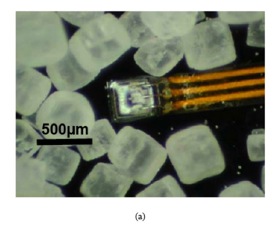
Thin film deposition technology allows the encapsulation done by depositing sacrificial layer and encapsulation material on top to provide the same protection with much less bonding area. By utilizing the thin film deposition technique, we fabricated one of the world smallest milli-g resolution, packaged accelerometer. The size of the whole packaged accelerometer is 500x500x300 µm, giving the weight around 200 nano-gram. Fig. 1 shows the picture of an accelerometer mounted on a flex circuit. For comparison, the background particles are table salt.
The sensitivity of the ultra-miniature accelerometer is shown in the Fig. 2. The performance difference between different devices is mostly due to different sensitivity and working bandwidth requirements. Hence, we can customize the accelerometer for various applications, ranging from automotive implementation to biomedical devices.
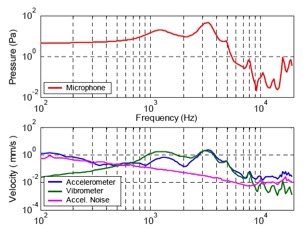
Due to its small size, this accelerometer is very suitable for bio-applications. Fig. 3 shows the diagram of measurement setup for application in cochlear implant. The miniature accelerometer was mounted on the middle-ear bone to pick up the vibration cause by the sound wave. By converting the vibration signal into sound wave signal, it can replace the external microphone and become fully implantable hearing aid system. Fig. 4 shows the photo of the experimental setup. The input transducer and reference input measurement are inserted into human’s ear canal from cadaver. By drilling a hole from the back, we mounted the accelerometer on the middle ear bone chain and measured the signal coming from transducer. Fig.5 shows the results from microphone, vibrometer, and accelerometer plotted on the same graph. By comparing the results from accelerometer and vibrometer we can find the accelerometer could pick up the vibration signal from 800 Hz to around 8000 Hz, which provides sufficient bandwidth for sound recognition.
References:
1. W.-T. Park, R.N. Candler, V. Ayanoor-Vitikkate, M. Lutz, A. Partridge, G. Yama, and T.W. Kenny, IEEE MEMS 2005, Miami, FL, January 2005,
2. “SUB-MM ENCAPSULATED ACCELEROMETERS:
A FULLY IMPLANTABLE SENSOR FOR COCHLEAR IMPLANTS”, Woo-Tae Park'", Kevin N. O'Connor, J. R. Mallon Jr.(')(4),Toshiki Maetani, Rob N. Candler, Vipin Ayanoor-Vitikkate"', Joseph B. Robertson, Sunil Puria, Thomas W. Kenny"'
Contact:
Kuan-Lin Chen




Fig. 1




Fig. 3





Fig. 2
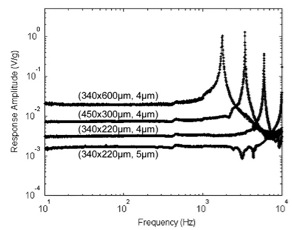
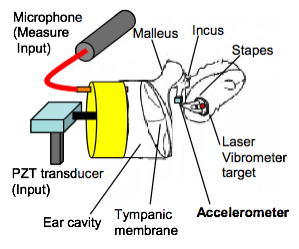





Fig. 4
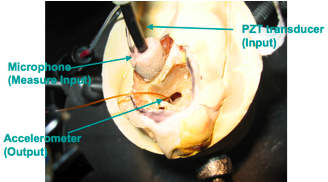





Fig. 5