|
Silicon Microelectromechanical Resonators
|
|

Double-Ended
Tuning Fork Resonator (DETF): Vibration of beams produces a timing signal
|
Silicon micromechanical
resonators provide a periodic signal that can be used as a frequency
reference in timing applications.
Silicon
resonators have the potential to displace the $12 billion timing market
currently dominated by quartz crystals.
More details…
|
|
Temperature Dependence Problem
|
|
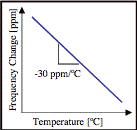
Silicon
Resonator Behavior: The
frequency of a silicon resonator decreases with increasing temperature.
|
Commercialization
of silicon frequency references has been hindered by the strong temperature
dependence of silicon resulting in frequency instability.
Unlike
quartz crystals, whose temperature dependence can be reduced by an
appropriate cut of the crystal, the silicon structure does not possess a
temperature dependent cut.
More details…
|
|
Compensation Methods
|
|
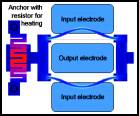
Active Temperature
Compensation: The temperature of the resonator is maintained at a constant
temperature using joule heating of a serpentine resistive structure
|
Compensation
methods to reduce the temperature dependence of frequency can be broadly
characterized as passive or active.
Active
compensation schemes rely on characterization of the temperature dependent
behavior and circuitry to correct for temperature changes.
Passive
compensation schemes seek to reduce the inherent temperature dependence of
the resonator.
More details…
|
|
Material Compensation
|
|
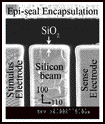
Composite Resonator:
Cross-section of composite beam with sense and actuation electrodes on
either side.
|
Material
compensation is a passive compensation method and is the primary focus of
my research.
Temperature
compensation is achieved by creating composite structures containing both
silicon and silicon dioxide.
Composite resonators show a 20X reduction in the temperature
sensitivity of frequency that is comparable to quartz crystal resonator
behavior.
More details…
|
|
Single Wafer Encapsulation Process
|
|
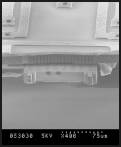
Encapsulated
Resonator: SEM of a DETF showing resonator under the surface of a wafer
with top metallization.
|
Composite
resonators were fabricated in a CMOS compatible, single-wafer encapsulation
process. This high-yield process encapsulates resonators in a hermetic
environment whose long-term stability has been established.
More details...
|
|
Enabling Technologies
|
|
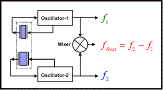
High
Accuracy Temperature Sensor:
Multiple composite resonators with different temperature
dependencies are combined to achieve a extremely temperature sensitive beat
frequency.
|
Material
compensated composite resonators can be combined with active temperature
compensation schemes to create high stability frequency references.
More details…
|
|
|